Superfast Broadband Deals: The 2026 UK Comparison Guide

Did you know that 82% of UK homes now have access to full-fibre technology, yet only 47% of eligible households have actually upgraded their connection? It’s frustrating to pay a premium every month whilst your video calls freeze or the Netflix buffer wheel spins in the kitchen. You probably want a connection that just works without needing a degree in telecommunications to understand the bill. We agree that finding the right superfast broadband deals shouldn’t feel like a full-time job or a gamble with your monthly budget.
Secure a reliable connection with transparent terms and no nasty surprises by following this guide. You’ll discover how to identify the best value superfast broadband deals whilst avoiding hidden costs and the mid-contract price hikes regulated by Ofcom. We will break down the 2026 market trends, explain the simplified “One Touch Switch” process, and clarify the confusing jargon between FTTC and FTTP. By following the latest connectivity data from the UK Government, you can ensure your home is fully prepared for the 2027 copper network retirement.
Key Takeaways
- Understand the technical difference between FTTC and ADSL to ensure your connection supports consistent speeds up to 80Mbps.
- Master the “Total Contract Cost” calculation to reveal the true price of superfast broadband deals beyond the headline monthly rate.
- Learn why upgrading to a modern WiFi 6 or WiFi 7 router is essential for maintaining reliable signal strength in every room of your home.
- Utilise the “One Touch Switch” process to change providers effortlessly whilst protecting your right to exit if minimum speeds are not met.
- Identify how to avoid mid-contract price hikes by spotting transparent pound-and-pence terms in your next service agreement.
What are Superfast Broadband Deals?
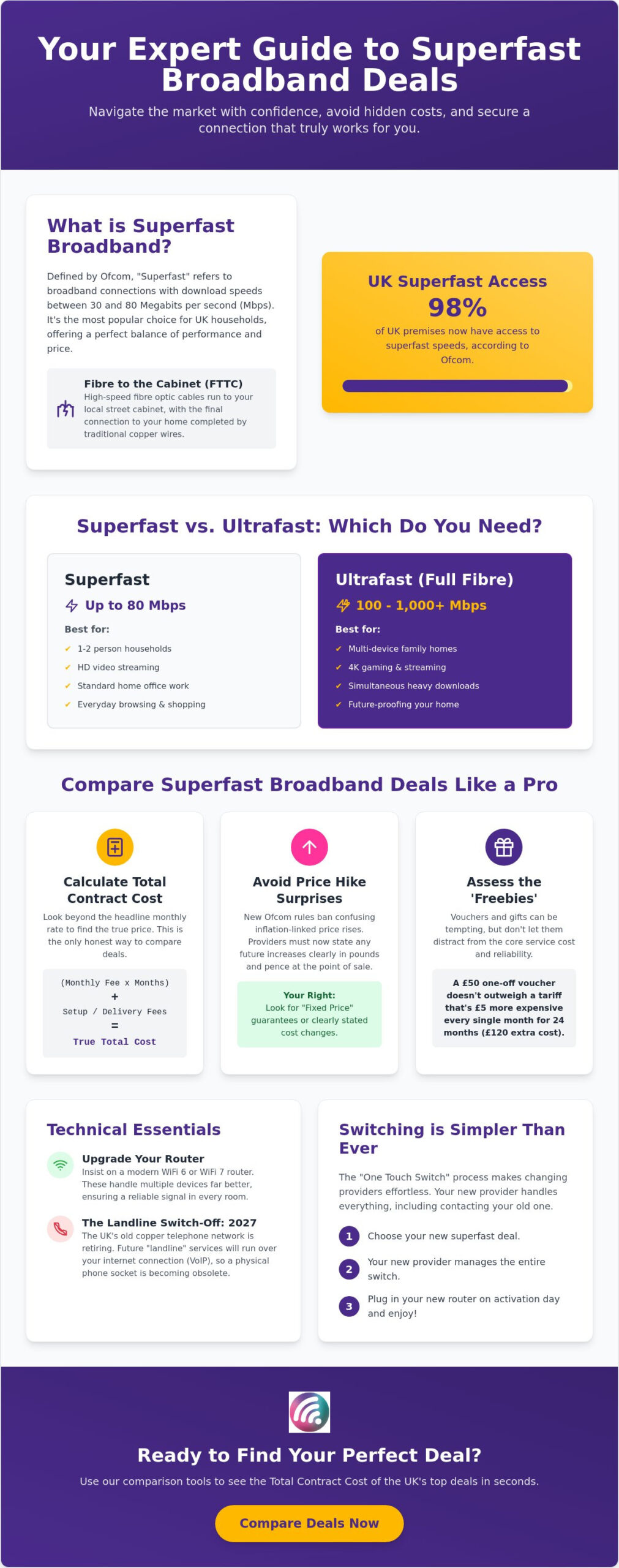
Superfast broadband refers to internet connections delivering download speeds between 30Mbps and 80Mbps. While newer gigabit options exist, these superfast broadband deals remain the most popular choice for UK households. They offer a reliable balance of affordability and performance for everyday digital tasks. According to Ofcom, 98% of UK premises now have access to these speeds. This technology typically relies on Fibre to the Cabinet (FTTC). Fibre optic cables reach your local street cabinet before switching to traditional copper wires for the final journey to your home. This infrastructure has been a cornerstone of the Internet in the United Kingdom for over a decade.
Superfast vs Ultrafast: Which do you need?
The main difference lies in the speed ceiling and the cable type used. Superfast peaks at 80Mbps, whilst Ultrafast or “Full Fibre” starts at 100Mbps and can exceed 1,000Mbps. If you want to understand the technological leap, read our guide on what is full fibre. Choose Superfast for 1-2 person households, HD streaming, and standard home office work. Opt for Ultrafast if you have a multi-device family home requiring 4K gaming or simultaneous heavy downloads. Most users find 60Mbps is the current benchmark for a smooth, lag-free experience.
Why copper cables slow you down
The “last mile” of your connection uses older copper cabling. This significantly affects the speed you actually receive on many superfast broadband deals. Your final megabits per second are dictated by your home’s physical distance from the green street cabinet. Signal strength degrades as it travels through copper. A house 500 metres away will see slower speeds than one right next to the cabinet. To see what your specific line can handle, use a fibre optic broadband checker before signing a new contract. This ensures you don’t pay for speeds your hardware cannot deliver.
How to Compare Superfast Broadband Deals Like a Pro
Don’t be fooled by low monthly prices. The only honest way to assess superfast broadband deals is by calculating the Total Contract Cost. This metric combines every penny you’ll pay over the full term, preventing nasty surprises. Many providers advertise a low basic rate but add significant setup fees or router delivery charges. When you evaluate a deal, add the activation cost to the sum of all monthly payments. This approach aligns with the UK Parliament’s definition of superfast broadband standards for consumer transparency. You can compare broadband deals using our advanced filters to see these total costs instantly.
Watch out for mid-contract price hikes
Protect your wallet from unpredictable inflation-linked increases. Since January 2025, Ofcom has banned providers from using confusing CPI-linked formulas. Companies must now state any price rises in clear pounds and pence at the point of sale. Whilst some providers offer “fixed price” guarantees for the entire term, others schedule a specific increase after twelve months. To find the true value, multiply the initial monthly cost by the number of months before the hike, then add the higher rate for the remaining term. Choosing an 18-month contract often provides a middle ground between flexibility and price security.
Evaluating the “Freebies” and Incentives
Reward cards and cashback can make superfast broadband deals look incredibly attractive. You might see offers for £50 vouchers or free smart home tech. Check our list of broadband with free gifts to see what’s currently available. However, stay focused on the core service. A one-off voucher doesn’t compensate for a tariff that’s £5 more expensive every month. If you are looking for long-term savings, prioritise a lower monthly bill over a shiny gadget. It’s often better to compare the market based on service reliability first.
Technical Requirements and Installation
Most superfast broadband deals operate via the Openreach network. If your home already has a standard telephone socket, you typically won’t need an engineer to drill new holes in your walls. The provider simply sends a new router through the post. To get the most from your connection, ensure your provider supplies a WiFi 6 or WiFi 7 router. These modern standards handle multiple devices better than older hardware. Always check your internet speed immediately after setup to verify the provider is meeting their “Minimum Guaranteed Speed” promise.
Do you still need a landline?
The UK is currently retiring the old copper-based public switched telephone network (PSTN), with a full switch-off scheduled for January 2027. According to Ofcom, traditional landlines are being replaced by digital services that run over your internet connection. Guidance from the UK Government confirms that most modern superfast plans now use SOGEA (Single Order Generic Ethernet Access). This technology delivers broadband over your phone line without requiring a traditional voice service. If you don’t use a handset, opting for a data-only plan can lower your monthly bill. However, if you prefer a home phone, you can find integrated options in our broadband and phone packages guide.
Self-installation vs Engineer visits
Switching is now a “plug and play” experience for the vast majority of users. Most transitions happen at the exchange level with zero downtime. You simply unplug your old router and connect the new one on your activation date. An engineer visit is usually only necessary if you’re installing a line in a new-build property or if you’re moving from a cable-only provider like Virgin Media to an Openreach-based one. If you are also looking to enhance your property’s perimeter or garden security during a move, Brookmans Park Fencing provides professional fencing services for residential and commercial sites. Ready to find your next connection? Compare the latest superfast broadband deals to see which providers offer free professional installation this month.
How to Switch and Secure the Best Deal
Switching your internet provider is now a streamlined, hassle-free process. Since September 2024, Ofcom’s switching guidance confirms that the “One Touch Switch” regulation allows you to only contact your new provider. They will manage the entire transition, including the cancellation of your old service. This eliminates the stress of dual billing or service gaps. “The process makes it easier for consumers to take advantage of the competitive market,” reports Ofcom. If your installation is delayed, you are entitled to automatic compensation of £10.05 per day. Review the latest superfast broadband deals from top-rated broadband providers to start your switch today.
Negotiating with your current provider
Start your search approximately 30 days before your current contract expires to avoid the “loyalty penalty.” Research suggests that customers who stay with the same provider out of contract often face significant price increases. Call your current provider’s retention department with a specific offer from a competitor. Use a direct script such as: “I’ve found a competitive superfast broadband deal elsewhere; can you match this price to keep my custom?” If they can’t offer a better rate, proceed with the switch. Under the Broadband Speeds Code of Practice, you can exit penalty-free if speeds stay below the minimum guaranteed level.
Specialist deals for students and renters
Flexibility is essential if you are in temporary or shared accommodation. Superfast speeds are usually the baseline for student houses where multiple people stream and game simultaneously. If you aren’t staying for a full year, look for no contract broadband or specialist short-term plans. These options allow you to cancel without heavy exit fees when your tenancy ends. Always use comparison tools to filter by contract length to find a plan that matches your specific living situation whilst maintaining high performance. This ensures you only pay for the months you actually need in your property.
Take Control of Your Home Connectivity
Finding the right balance between speed and cost doesn’t have to be a complicated chore. You now have the tools to look beyond headline prices and calculate the true value of superfast broadband deals by using the Total Contract Cost metric. Remember that 2026 regulations protect you from hidden hikes, whilst the One Touch Switch process removes the stress of dealing with your old provider. By checking your local infrastructure and ensuring you have modern WiFi 6 or 7 hardware, you can guarantee a reliable connection for every device in your household.
While ensuring your home is well-connected, don’t forget your mobile needs when travelling; globalesim.pl provides eSIMs that offer immediate internet access from the moment you arrive at your destination.
We have performed the heavy lifting of research and comparison so you don’t have to. Our expert guides are fully updated for 2026 regulations, providing an independent and unbiased referral service that helps you navigate the market with confidence. You can compare the latest superfast broadband deals and save today by scanning 30+ UK providers in seconds. It’s time to stop overpaying for a service that doesn’t meet your needs. Start your search now and enjoy the peace of mind that comes with a transparent, high-performance connection.
Frequently Asked Questions
What is the difference between superfast and ultrafast broadband?
Superfast broadband provides download speeds between 30Mbps and 80Mbps, whereas ultrafast broadband offers speeds of 100Mbps or higher. Whilst ultrafast relies on full-fibre cables directly to your home, superfast often uses existing copper infrastructure for the final stretch. This ensures superfast remains the most affordable and widely available option, according to the House of Commons Library definitions.
Can I get superfast broadband without a phone line in 2026?
You can absolutely get a connection without a traditional phone service in 2026. Most modern providers now offer “standalone” broadband using SOGEA technology, which delivers data over your line without requiring a voice plan. This allows you to avoid paying for a landline you don’t use, effectively lowering your monthly outgoings. Detailed guidance on this is available via the UK Government digital transition portal.
How long does it take to switch to a new superfast broadband deal?
The switching process typically takes between 10 and 14 working days from the moment you sign up. This timeframe accounts for the mandatory 14-day cooling-off period and the time required for your new router to arrive in the post. Because of the modern switching systems, you won’t experience a total loss of service during this transition. You can browse the latest superfast broadband deals and start your switch in just a few minutes.
Will my broadband price go up during my contract?
Your monthly cost will only increase if the provider explicitly stated the rise in pounds and pence at the point of sale. Since the 2025 ban on inflation-linked formulas, providers must be transparent about future costs. To ensure total budget security, look for superfast broadband deals that feature a “Fixed Price Guarantee” for the entire duration of the contract. This prevents any unexpected adjustments to your monthly bill.
Is 80Mbps fast enough for 4K streaming and gaming?
An 80Mbps connection is more than sufficient for high-quality 4K streaming and online gaming. A single 4K stream typically requires 25Mbps, so an 80Mbps line can comfortably support three simultaneous streams with bandwidth left over for other devices. For gaming, this speed ensures fast patch downloads, whilst your physical distance from the exchange will dictate the latency for online play. It’s a pragmatic choice for most UK families.

Article by
Elaine Lang
Elaine has over 20 years across Marketing, Communications and Public Relations in the UK. She has worked across large UK corporations, including Commercial Banks and Airports, to online consumer finance and technology solutions. Elaine has post graduate qualifications in Marketing from the Chartered Institute of Marketing (CIM) and the Industry of Direct Marketing (IDM). She is a lifelong feline fan, sharing her home with around 4-6 cats for many years. This of course can be a challenge when trying to work at home, as they like to try to help!